



Our Baking and Pastry Shops Financial Model Structure covers all the essential aspects you need to consider when starting or scaling a Baking and Pastry Shops business. By following this structure, you can better understand your revenue streams, costs, and assets, helping you optimize profitability and strategically plan for growth.
Embarking on the journey of initiating or expanding a Baking and Pastry Shops enterprise represents a stimulating opportunity that necessitates meticulous financial strategizing. A robust financial blueprint for such an establishment encompasses various revenue streams, direct costs, essential personnel, expenses, and assets crucial for the success of your endeavor. This Baking and Pastry Shops financial model framework can also yield insights into novel and lucrative revenue streams, thereby enhancing your operational efficiency.
The Baking and Pastry Shops financial model structure
The structure of a financial model for Baking and Pastry Shops commences with an in-depth analysis of potential revenue streams. In this segment, we will examine typical revenues, cost of goods sold, employees, operating expenses, assets, and funding avenues pertinent to this business domain. However, navigating this landscape can be complex because of the myriad variables involved. Although the endeavor may seem daunting, a well-prepared strategy can illuminate the path forward.
Revenues
- Retail Sales: Revenue can be calculated by multiplying the price of baked goods with the number of units sold.
- Wholesale Contracts: Enables revenue calculation through volume-based pricing, achieved by establishing contracts with cafes, restaurants, and supermarkets.
- Online Orders: Present another opportunity; for these orders, placed via your website or delivery apps, revenue is estimated by multiplying the price per order by the anticipated number of orders.
- Catering Services: Yield revenue that can be calculated based on event size, menu pricing, and the frequency of events.
- Workshops and Classes: Require careful revenue calculations by determining class sizes alongside pricing per participant.
- Custom Cakes: Offer a unique challenge: revenue from personalized cake orders is estimated by averaging the price per cake multiplied by the expected orders.
- Subscription Boxes: Involve setting monthly fees for delivered baked goods while projecting the number of subscribers to maximize profitability.
Cost of goods sold
- Ingredient costs (such as flour, sugar, and butter) are directly related to production; however, other baking materials may also play a role.
- Packaging materials (including boxes, bags, and labeling) are essential for deliveries and in-shop sales.
- Utilities for baking—like electricity and gas—incur expenses that are directly attributed to baking processes, although these costs can fluctuate. Because of this, managing these factors is crucial for maintaining profitability.
Employees
- Bakers: Responsible for producing high-quality baked goods; however, pastry chefs specialize in creating intricate pastries and desserts.
- Cashiers: Handle sales transactions and customer service at the point of sale, but kitchen assistants support bakers and chefs with ingredient preparation and cleaning.
- Marketing and Sales Coordinators: Develop strategies to increase customer engagement and sales, because this is crucial for business success. Although each role is distinct, they all contribute to the overall operation of the establishment.
Operating expenses
- Rent (monthly expenditures for leasing your shop space) is a significant consideration.
- Utilities: These recurring costs include water, electricity and gas, which are essential not only for production but also for overall functionality.
- Marketing Costs: Expenses related to promotions and advertising are crucial; however, they can vary greatly depending on the strategies employed.
- Insurance: This encompasses coverage for property, liability, and employees and is vital for protecting your business.
- Supplies: Non-food items necessary for operations such as cleaning products are often overlooked, although they play a critical role in maintaining a safe environment.
- Licenses and Permits: Represent costs for required legal documents, which are essential; thus, neglecting them can lead to complications.
- Maintenance: Involves regular repair costs for equipment and shop upkeep, because without it, operational efficiency may decline.
- Software Subscriptions: Monthly fees for POS and accounting software are another necessary expense, but they can sometimes feel burdensome.
- Professional Fees: Costs for legal, accounting, or consulting services are often underestimated, yet they can be pivotal for business growth.
- Salaries and Wages: Employee compensation extends beyond just bakers and kitchen staff, as they encompass the entire workforce, which is necessary for smooth operations.
Assets
- Commercial Ovens: Essential for production capacity and quality are crucial.
- Mixers: Industrial-grade equipment facilitates dough and batter preparation.
- Display Cases: Serves the purpose of showcasing baked goods to customers, however, refrigerators and freezers play a significant role in preserving ingredients and finished products.
- Point of Sale Systems: Technology for sales processing and inventory management are also vital, but their effectiveness can diminish without proper integration. This complexity arises because the various components must function cohesively, although challenges may occur during implementation.
Funding options
- Bank Loans: Traditional lending involves structured repayment schedules, however, Angel Investors provide capital for growth through individuals.
- Small Business Grants: Non-repayable funds are offered by government or private institutions.
- Crowdfunding: Raising capital is achieved through a large number of people via online platforms, while Vendor Financing allows obtaining credit from suppliers for purchasing inventory or equipment.
Driver-based financial model for Baking and Pastry Shops
Driver-based financial model for Baking and Pastry Shops is essential. A truly professional financial model revolves around operating KPIs (drivers) that are crucial to success. These KPIs help simulate business dynamics.
- Revenue Per Square Foot serves as a metric to gauge your shop’s space utilization effectiveness.
- Customer Footfall indicates the number of customers visiting within a given timeframe.
- Baking Time Efficiency measures how efficiently time is spent in baking processes.
- Average Order Value represents the average amount spent per customer transaction.
- Ingredient Cost Percentage reflects the proportion of ingredient costs relative to total sales.
- Inventory Turnover Rate: The frequency at which inventory is sold and replaced over a period.
- Staff Hours per Unit Sold: This measures labor efficiency in relation to sales volume.
- Marketing ROI: Understanding returns on marketing expenditures.
Driver-based financial planning involves identifying key activities (drivers) that have the highest impact on business results; however, building financial plans based on those activities is crucial. This process enables one to establish relationships between financial outcomes and necessary resources such as personnel, marketing budgets, and equipment. If you want to know more about driver-based financial planning and why it is the right way to plan, see the founder of Modeliks explaining it in the video below.
The financial plan output
The objective of the financial forecast outputs is to offer clarity to you, your management team, board, or investors about the future performance of your Baking and Pastry Shops business. It should demonstrate that the plan is well-thought-out, realistic, and achievable; however, it must also identify the investment needed to implement the plan, along with the anticipated return on investment. To achieve these goals, here is a one-page template on how to effectively present your financial plan.
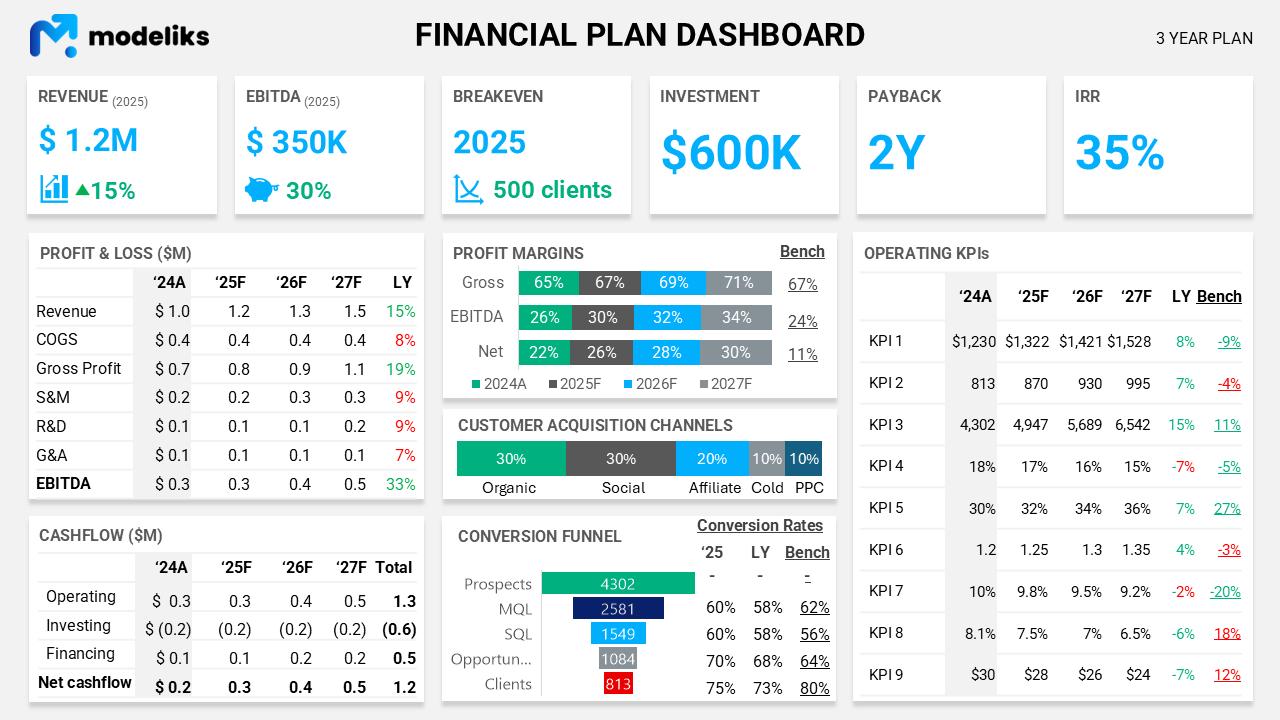
In addition to this summary, you will need to provide the three projected financial statements:
- Profit and Loss: Projected income and expenses to show profitability.
- Balance Sheet: Outlines assets, liabilities, and equity to understand financial position.
- Cash Flow Statement: Tracks cash inflows and outflows to ensure liquidity.
Baking and Pastry Shops financial model summary
A professional financial model for a Baking and Pastry Shops business is an invaluable tool that helps you deliberate on your business strategies; it pinpoints the resources needed to meet targets, sets achievable goals, measures performance accurately, secures necessary funding and makes informed decisions to manage and expand your business effectively. However, this model is essential because it provides clarity and structure. Although it may seem complex, the benefits far outweigh the challenges.
If you need help with your financial plan, try Modeliks , a financial planning solution for SMEs and startups or contact us at contact@modeliks.com and we can help.
Author:
Blagoja Hamamdjiev
, Founder and CEO of
Modeliks
, Entrepreneur, and business planning expert.
In the last 20 years, he helped everything from startups to multi-billion-dollar conglomerates plan, manage, fundraise, and grow.