


Our Café and Coffee Shops Financial Model Structure covers all the essential aspects you need to consider when starting or scaling a Café and Coffee Shops business. By following this structure, you can better understand your revenue streams, costs, and assets, helping you optimize profitability and strategically plan for growth.
Opening a café or coffee shop represents an exhilarating venture; however, like any business, success is intricately linked to financial planning. A comprehensive Café and Coffee Shops financial model not only guides you through managing typical revenues, costs, and assets but also paves the way for growth by highlighting potential new revenue streams. Understanding this model is crucial, whether you’re starting from scratch or aiming to scale operations.
The Café and Coffee Shops financial model structure
The Café and Coffee Shops financial model outlines standard revenues, direct costs, employees, expenses, and assets you need to consider. This model could potentially inspire new and profitable revenue streams, although it requires careful analysis and adaptation.
Revenues
Typical revenue streams consist of:
- Coffee Sales: This is calculated by price charged per cup multiplied by the number of cups sold.
- Pastries and Snacks: Revenue from baked goods and snacks is based on the price per item and quantity sold; however, these can vary significantly.
- Beverage Sales: Include teas, smoothies, and other drinks, calculated similarly to coffee sales.
- Event Hosting: Generates earnings from hosting events, usually a fee per event or per head, although this can fluctuate depending on demand.
- Merchandise Sales: Yield profits from selling branded items, calculated by item price and sales volume; this aspect can be quite lucrative.
- Wholesale Supplies: Provide income from supplying coffee or snacks to local stores or offices, but the market can be competitive.
- Subscription Services: Involve regular deliveries of coffee or pastries, where income is based on subscription fees. Because of these diverse streams, businesses can maintain stability in fluctuating markets.
Cost of Goods Sold
Cost of goods sold (COGS) includes direct costs tied to generating revenues:
- Coffee Beans: Purchase cost directly relevant to coffee sales.
- Ingredients for Pastries and Snacks: Costs associated with flour, sugar, chocolate, etc.
- Beverage Ingredients: Include tea leaves, milk, fruits for smoothies, etc.
- Event Supplies: Costs for supplies specific to hosting events can vary significantly.
- Merchandise Production: Costs to produce branded merchandise.
Employees
Typical employees in a café and coffee shop include:
- Baristas: Prepare coffee and beverages.
- Bakers: Responsible for creating pastries and snacks.
- Servers: Assist with customer service and order management.
- Managers: Oversee daily operations, employee scheduling, and financial targets.
- Cleaning Staff: Maintain cleanliness and hygiene standards.
Operating expenses
Typical operating expenses encompass:
- Rent: Represents the cost of space for the café.
- Utilities: Includes electricity, water, and gas.
- Marketing: Reflects expenditures on promotional activities.
- Salaries and Wages: Consist of payments to staff and management.
- Insurance: Provides coverage for property, liability, and employees.
- License and Permits: Entail fees necessary for legal compliance.
- Maintenance: Denotes regular upkeep of premises and equipment.
- Office Supplies: Involve stationery and day-to-day materials.
- POS System Costs: Include software and hardware essential for sales and inventory.
- Depreciation: Signifies the reduction in asset value over time.
Assets
Crucial assets for such a business encompass:
- Coffee Machines: Serve as primary equipment for coffee preparation.
- Ovens and Kitchen Equipment: Necessary for baking and food preparation.
- Furniture: Tables, chairs, and décor create an ambiance for customers.
- POS System: Essential for managing sales and inventory.
- Refrigeration Units: Vital for preserving ingredients and perishables.
Funding Options
Funding options for a café and coffee shop business may encompass personal savings, bank loans, and investor financing; however, crowdfunding and grants also play significant roles.
- Personal Savings: Using funds to initiate the business is a common approach.
- Bank Loans: Borrowing from financial institutions can provide necessary capital.
- Investor Financing: Securing funds from private investors or venture capitalists can be advantageous.
- Crowdfunding: Raising small amounts of money from a large number of people, usually via online platforms, has gained popularity.
- Grants: Applying for grants from governmental or private institutions can be competitive but supports small businesses effectively.
Driver-based financial model for Café and Coffee Shops
A truly professional Café and Coffee Shops financial model is built on operating KPIs (key performance indicators) , also known as “drivers” relevant to the industry.
Typical KPIs include:
- Daily Foot Traffic: The number of customers visiting the café each day.
- Average Spend per Customer: The typical amount each individual spends during a visit.
- Customer Retention Rate: The percentage of patrons who return.
- Profit Margin per Item: The proportion of profit derived from each sale.
- Cost per Acquisition: The expense involved in gaining each new customer.
- Table Turnover Rate: The frequency at which tables are occupied and vacated.
- Inventory Turnover Rate: The rate of inventory use and replenishment.
Driver-based financial planning involves identifying crucial activities (or ‘drivers’) that significantly affect business outcomes and constructing financial plans based on those activities. This approach allows businesses to establish relationships between financial results and the resources necessary to achieve these outcomes, such as personnel, marketing budgets, and equipment.
If you want to know more about driver-based financial planning and why it is the right way to plan, see the founder of Modeliks explaining it in the video below.
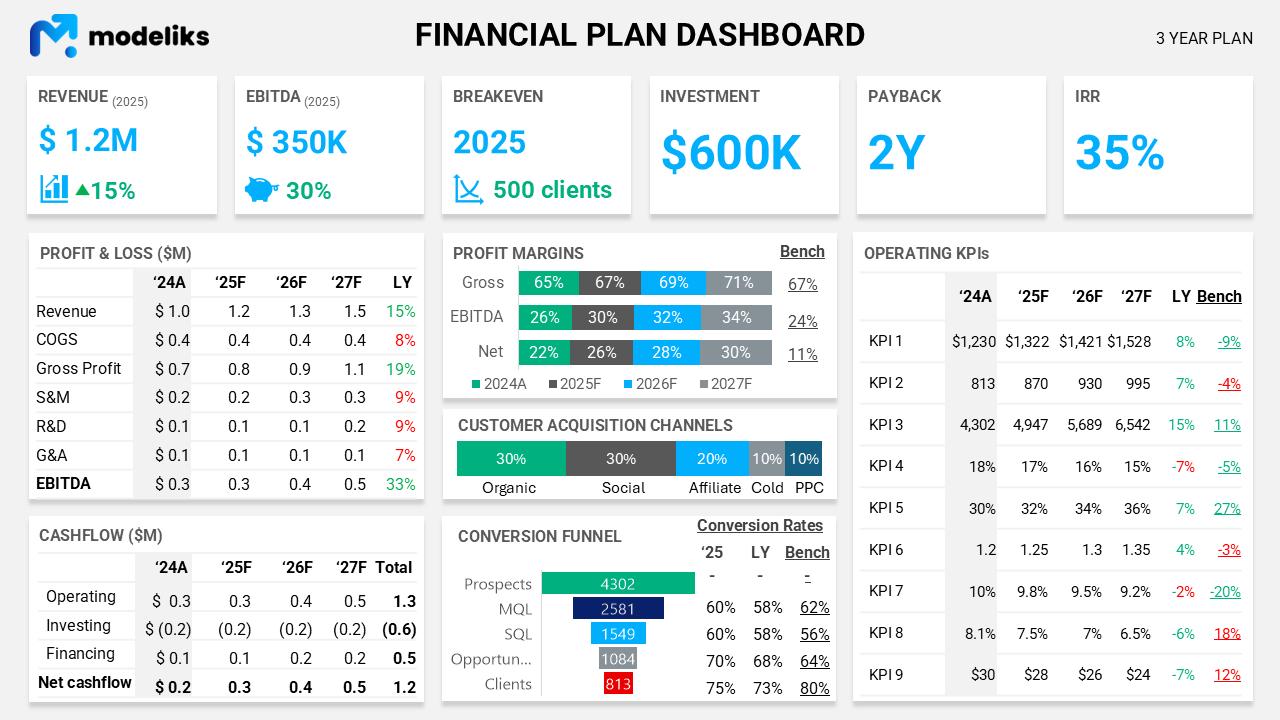
The financial plan output
The objective of financial forecast outputs is to enable managers, boards, or investors to:
- Quickly comprehend how the Café and Coffee Shops business will perform in the future.
- Gain assurance that the plan is well thought-out, realistic, and achievable.
- Discern what investment is required to implement this plan and what the expected return will be.
To achieve these goals, here is a one-page template for effectively presenting your financial plan.
Beyond this summary, you will need three projected financial statements:
- Profit and Loss Statement: Details revenue, expenses, and profits over a given period.
- Balance Sheet: Shows the company’s assets, liabilities, and equity at a specific moment in time.
- Cash Flow Statement: Displays cash inflows and outflows over a period.
A professional Café and Coffee Shops financial model will assist you in critically analyzing your business because it identifies resources needed to achieve your targets, setting goals, measuring performance, raising funds, and making informed decisions to manage and grow your business effectively. However, this requires careful planning and execution. Although financial models can be complex, their value is undeniable.
If you need help with your financial plan, try Modeliks , a financial planning solution for SMEs and startups or contact us at contact@modeliks.com and we can help.
Author:
Blagoja Hamamdjiev
, Founder and CEO of
Modeliks
, Entrepreneur, and business planning expert.
In the last 20 years, he helped everything from startups to multi-billion-dollar conglomerates plan, manage, fundraise, and grow.