



Our Food Financial Model Structure covers all the essential aspects you need to consider when starting or scaling a Food business. By following this structure, you can better understand your revenue streams, costs, and assets, helping you optimize profitability and strategically plan for growth.
Financial planning is a critical undertaking for anyone considering starting or expanding a food business. Whether you’re opening a café, launching a catering service, or running a food truck, a well-structured food financial model can provide a roadmap for your business operations. This model should consider the typical revenue streams, direct costs, employees, operating expenses, assets, and potential funding sources. However, such a model can inspire you to explore new and profitable revenue streams, because it enables one to identify opportunities for growth. Although the process may be daunting, it is necessary for success.
The Food financial model structure
Creating a structured food financial model for a food business involves understanding various components. This section outlines critical elements you need to focus on; however, it is essential to grasp the nuances of each aspect. Although the process may seem daunting, it can be approached systematically. Because these components interplay, it is crucial to analyze them thoroughly. This ensures that your model remains robust and adaptable—but remember, attention to detail is key.
Revenues
- Dining Services: Revenue can be calculated by multiplying the average customer spend with the number of customers served each day; then, this total must be multiplied by the operating days.
- Catering Services: Estimate revenue based on the number of catering events multiplied by the average event charge.
- Food Delivery: Involves determining revenue by analyzing the daily delivery orders received and the average order value.
- Wholesale Supply: Calculated by assessing the quantity of food items supplied to other businesses and their respective prices per unit.
- Retail Sales: Necessitate estimating revenue by tracking the sales volume of packaged food items, plus their selling prices.
- Loyalty Programs: Although often overlooked, can contribute to revenue through membership fees and an increase in repeat customer purchases.
- Special Events or Festivals: Generate revenue that is calculated from ticket sales and food purchases during the event.
- Online Cooking Classes: Because they attract a significant audience, should be evaluated based on the number of registered participants and the price per class.
Cost of goods sold
The costs directly associated with producing your food products must be classified: raw materials, direct labor and other specific production costs for each revenue stream listed above. However, this classification is crucial, because it allows for a better understanding of financial dynamics. Although some may overlook these details, they are essential for effective management and strategic planning. But, without an accurate assessment, one risks misallocating resources, which could lead to inefficiencies in the long run.
Employees
- Chef: Responsible for menu planning, food preparation, and kitchen management.
- Kitchen Staff: Assist in food preparation and maintain cleanliness and order in the kitchen.
- Waitstaff: Engage with customers, take orders, and serve food and beverages.
- Delivery Personnel: Ensure timely delivery of food orders to customers’ locations.
- Sales and Marketing Manager: Develops strategies to boost revenue through marketing campaigns and sales promotions because this is essential for success.
Operating expenses
- Rent: A regular payment crucial for the premises utilized by the business.
- Utilities: Costs related to electricity, water, and gas can fluctuate significantly; however, they are essential for daily operations.
- Marketing and Advertising: Expenses incurred to promote the business are also vital because they directly impact visibility and customer engagement.
- Insurance: Premiums provide coverage against risks such as property damage or liability claims, representing another necessary expenditure.
- Licenses and Permits: Fees for obtaining necessary legal operational permissions can be cumbersome, but they ensure compliance with regulations.
- Equipment Maintenance: Costs stemming from regular servicing and repair of kitchen tools, often overlooked, although important for efficiency.
- Packaging: Expenses for boxes, wrappers, and other materials used to package food items cannot be neglected, because they affect presentation and safety.
- Cleaning Supplies: The cost of materials utilized for maintaining hygiene standards is essential, as they uphold health regulations.
- Employee Benefits: Include health insurance, pension contributions, and various perks provided to employees; this fosters a motivated workforce.
- Accounting and Professional Fees: Reflect the costs associated with legal, tax, and financial consultation services, which are critical for sustainable business practices.
Assets
- Kitchen Equipment: Essential tools and machinery for cooking and food preparation are crucial; however, Delivery Vehicles play an equally important role.
- Furniture and Fixtures: Like tables, chairs, and other permanent installations are necessary but often go overlooked.
- Point of Sale System: Technology used to record sales transactions and manage inventory is vital because this ensures efficient operations.
Funding
- Bank Loans: Represent borrowed capital that must be paid back with interest over time; they are often utilized for startup or expansion.
- Angel Investors: Individuals who provide capital in exchange for ownership equity or convertible debt—play a crucial role in financing.
- Venture Capital: Involves investment provided by firms to startups that possess high growth potential.
- Grants: Although non-repayable funds, are offered by governments or organizations to support businesses.
- Personal Savings: The owner’s funds serve as initial capital for the enterprise, but this can be limiting because it may not suffice for larger ventures.
Driver-based financial model for Food
A professional food financial model for a food business is grounded in operating KPIs (Key Performance Indicators) relevant to the industry; identifying these metrics is vital for accurate financial planning.
- Customer Footfall: This measures the number of customers visiting the business.
- Average Transaction Value: Indicates the average amount spent by each customer.
- Food and Beverage Costs: Tracks expenses incurred in purchasing raw materials.
- Table Turnover Rate: Measures the frequency of table occupancy change.
- Customer Retention Rate: Determines the percentage of repeat customers.
- Inventory Turnover: Indicates how often inventory is used and replaced.
- Employee Productivity: Measures employee efficiency in fulfilling their duties.
- Revenue per Square Foot: Evaluates revenue generated relative to the business’s physical space.
Driver-based financial planning involves identifying key activities or ‘drivers’ that significantly influence your business results. Building financial plans around these activities allows you to establish relationships between financial outcomes and necessary resources. If you wish to learn more about driver-based financial planning: why it is the right approach to plan, watch the founder of Modeliks explain it in the video below. However, many overlook this methodology because it can provide profound insights. Although the concept seems straightforward, its implementation can be quite complex.
The financial plan output
The aim of financial forecast outputs should be to enable you, your management team, board, or investors to quickly grasp how your food business will fare in the future. You will gain reassurance that the plan is well-considered, realistic and achievable. It is essential to comprehend what investment is necessary to execute this plan and what the anticipated return on investment will be. To accomplish these objectives, here’s a concise template on how to effectively showcase your financial plan.
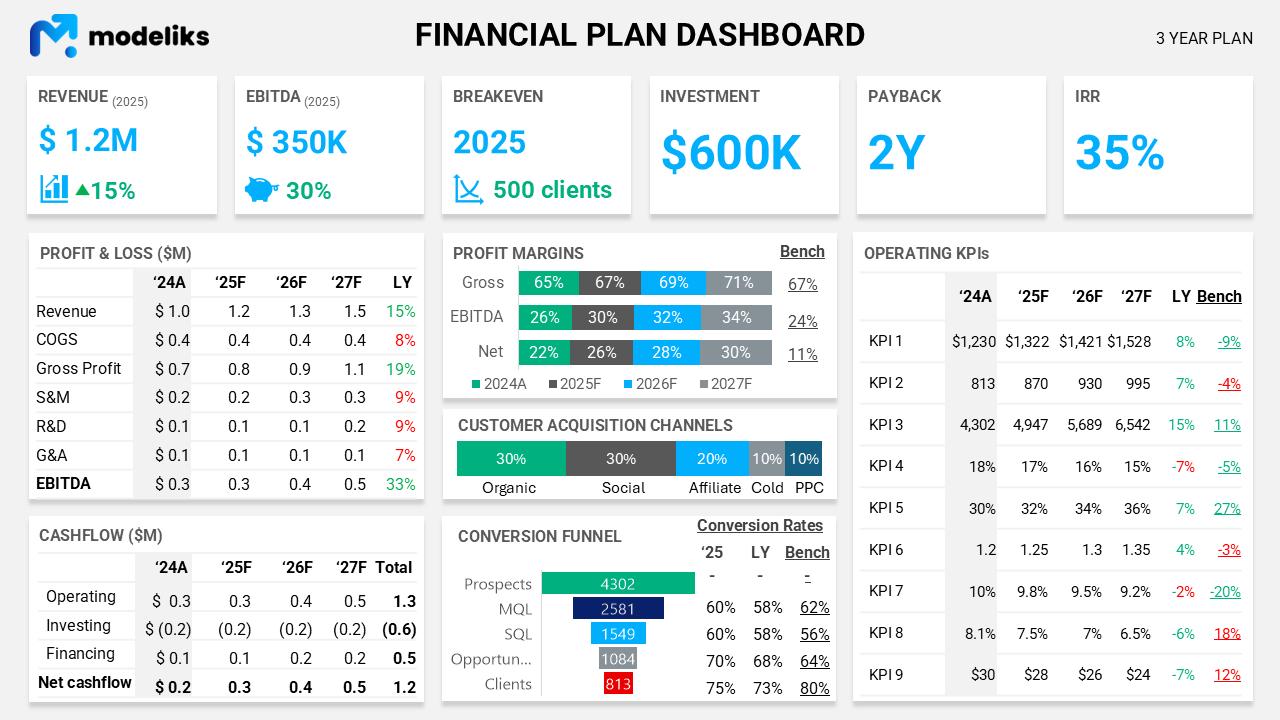
In addition to this summary of your plan, you will require three projected financial statements because they are crucial for understanding the overall picture. However, be mindful of the details within each statement, as they can significantly impact your strategy. Although the one-page overview is important, the depth of analysis in the statements cannot be overlooked.
- Profit and Loss
- Balance Sheet
- Cash Flow Statement
Food financial model summary
A professional food financial model for a food business helps you think through your business; it identifies the resources you need to achieve your targets. You can set goals, measure performance, and raise funding. However, this model enables you to make confident decisions to manage and grow your business, but it requires careful consideration. Although it may seem complex, it is essential because it provides clarity and direction.
If you need help with your financial plan, try Modeliks , a financial planning solution for SMEs and startups or contact us at contact@modeliks.com and we can help.
Author:
Blagoja Hamamdjiev
, Founder and CEO of
Modeliks
, Entrepreneur, and business planning expert.
In the last 20 years, he helped everything from startups to multi-billion-dollar conglomerates plan, manage, fundraise, and grow.