



Our Food Truck Financial Model Structure covers all the essential aspects you need to consider when starting or scaling a Food Truck business. By following this structure, you can better understand your revenue streams, costs, and assets, helping you optimize profitability and strategically plan for growth.
Initiating a food truck enterprise can be an exhilarating endeavor; however, it necessitates meticulous financial planning to guarantee success and growth. Developing detailed Food Truck financial models is crucial because it delineates potential revenue streams, costs, and essential resources. By identifying these factors, one might also uncover innovative revenue opportunities that could lead to profitability. Although it seems straightforward, the intricacies involved in this industry are often underestimated.
The Food Truck Financial Model Structure
The financial model for a food truck business encompasses various elements, such as revenue streams, direct costs, employees, operating expenses, and assets. Below is a detailed breakdown of these components; however, one must consider the interconnections among them. Revenue streams can fluctuate, because they depend on location and customer preferences. Direct costs, although significant, often vary with market trends; this can impact overall profitability. Operating expenses are crucial as well, but they can be managed effectively through strategic planning. Employees play a vital role in ensuring success, yet their training and management can be challenging. Thus, each element is interconnected, and understanding this complexity is essential for effective financial planning.
Revenues
- Sales from Food and Beverages: Requires calculation; this involves multiplying the number of items sold daily by the average price per item.
- Catering Services: Necessitate estimating revenues based on the number of catering events per month and average revenue per event.
- Merchandise Sales: Can be considered; selling branded merchandise might yield potential profits by estimating customer interest and average price.
- Special Event Participation: Is also crucial; although one must pay a vendor fee, this can lead to significant revenue, especially from high foot traffic.
- Online Orders and Delivery: Present another opportunity; one should estimate revenue by considering average order size and frequency, but remember to factor in customer preferences.
Cost of Goods Sold
- Ingredients and Supplies: Must be evaluated to determine the total cost, which depends on both quantity and price of the components needed for your menu.
- Packaging Materials: E.g., containers, cutlery, napkins are also crucial, as they contribute to overall expenses; however, one must consider these costs carefully.
- Beverage Costs: Cannot be overlooked; it’s essential to include expenses associated with drinks sold, because they (soft drinks and bottled water) can significantly impact profitability. Although this may seem tedious, a thorough calculation is vital for success.
Employees
- Chef/Cook: Responsible for preparing menu items & maintaining food quality.
- Service Staff: Manages customer interactions, takes orders, however serves food.
- Driver/Setup Worker: Handles logistics of moving truck and setting up at locations. This role requires attention to detail, because it ensures a seamless experience for patrons, although it can be quite demanding at times.
Operating Expenses
- Fuel Costs: Regular and often fluctuating expenses associated with fueling the truck.
- Maintenance and Repairs: Encompass both scheduled and unscheduled work necessary to keep the vehicle operational.
- Permits and Licensing: Required; local permits and business licenses are essential for legal compliance.
- Insurance: Specifically vehicle and liability insurance—is crucial for protection against potential risks.
- Marketing and Advertising: Expenses play a significant role in promoting your business through various channels, although they can vary widely in cost.
- Rental Costs: Can arise from fees for parking the truck in prime locations or participating in events, but these fees can be offset by increased visibility.
- Utilities: Such as electricity and water, are costs that must be accounted for because they are necessary for operation.
- Uniforms: Branded uniforms are often purchased for employees, which can enhance professionalism.
- Accountancy and Software Fees: Are vital for managing finances effectively, although they can be an added financial burden.
- Miscellaneous Supplies: Include other small items that are needed for daily operations, and these costs can accumulate over time, impacting the overall budget.
Assets
- Food Truck: The primary asset serving as the central hub of your business operations.
- Kitchen Equipment: Grills, fryers, ovens, and refrigeration units contribute significantly to productivity.
- POS System: A point of sale system enables you to manage transactions efficiently; however, it requires proper integration.
Funding Options
- Personal Savings: This can be an effective means to finance initial investment and is often a prudent choice.
- Bank Loans: May also be considered, as obtaining loans from banks, however, necessitates a solid business plan.
- Investors: Although attracting private investors can be challenging, it is essential because their belief in your business model can significantly impact your success.
- Crowdfunding: Represents another avenue; raising small amounts of money from a large number of people, typically through online platforms, can provide necessary capital. Yet, one must navigate the complexities of each method.
Driver-Based Financial Model for Food Truck
A truly professional Food Truck financial model is constructed upon operating KPIs (or “drivers”) that are pertinent to the venture. These drivers are essential because they help predict financial outcomes and guide strategic decisions. Here are some examples of key operating KPIs for a food truck business :
- Average Ticket Size: The average amount spent by each customer
- Customer Turnover Rate: The number of customers served during peak hours
- Event Participation Rate: The frequency and success of events attended
- Social Media Engagement: How active and responsive your target audience is to your social media activities
- Repeat Customer Rate: The percentage of customers who return for additional purchases
- Inventory Turnover: The rate at which inventory is used and replenished
- Labor Efficiency Ratio: Output per labor hour, aiding in optimizing staffing levels
However, it is important to analyze these metrics holistically; this ensures that the business remains agile and responsive to changing market conditions. Although some KPIs may seem more significant than others, each plays a role in influencing overall performance.
Driver-based financial planning involves identifying key activities, or “drivers,” that exert the most significant influence on business outcomes; thus, it constructs financial plans around those activities. This approach establishes connections between financial results and necessary resources such as personnel, marketing budgets, and equipment. If you wish to learn more about driver-based financial planning—particularly why it is optimal for planning—consider watching the founder of Modeliks elucidate the concept in the video below.
The Financial Plan Output
The objective of financial forecast outputs should enable you, your management team, board, or investors to: quickly comprehend how your food truck enterprise will perform in the future. Gain comfort, however, that the plan is well thought through, realistic, and achievable. Understand what investment is necessary to implement this plan and what will be the return on that investment. To achieve these goals, here is a one-page template on how to effectively present your financial plan.
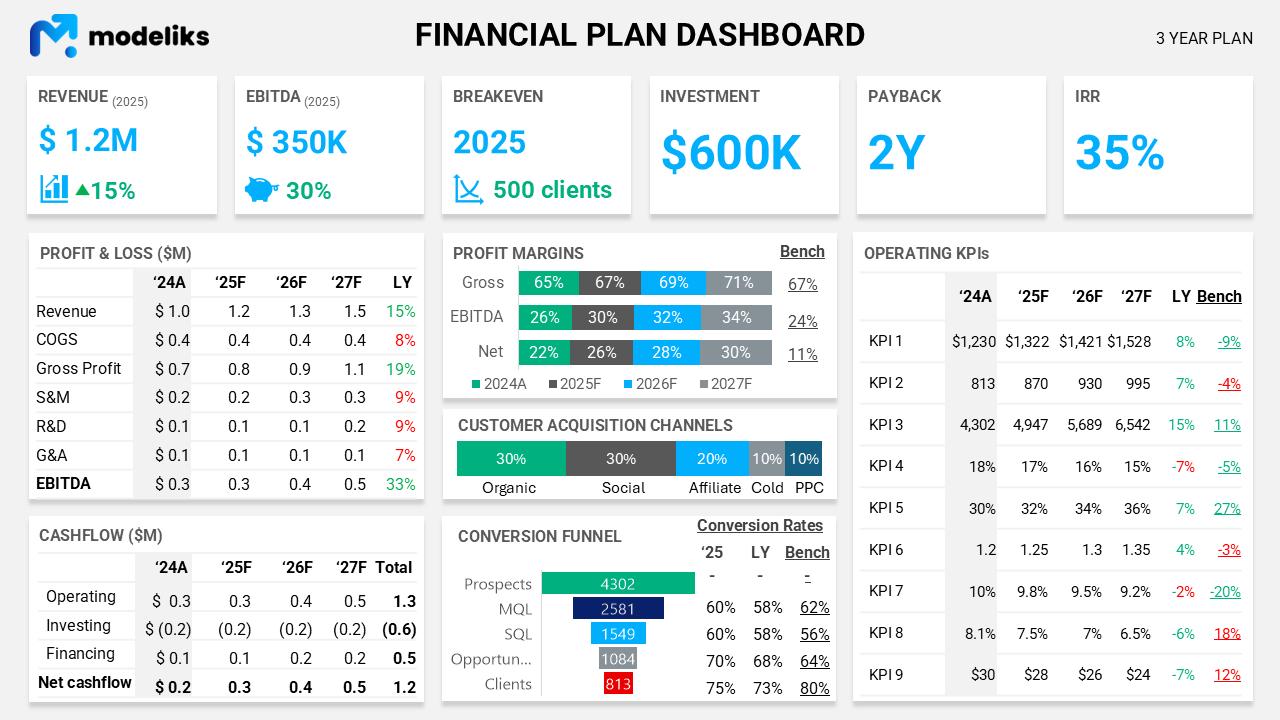
Apart from this one-page summary, your plan must include three projected financial statements:
- Profit and Loss: A statement revealing the revenues, costs, and expenses during a specific period.
- Balance Sheet: A snapshot of your business’s financial condition at a particular moment, detailing assets, liabilities, and equity.
- Cash Flow Statement: A record of the money flowing in and out, crucial for grasping the liquidity position.
Although this information is vital, it is essential to ensure clarity and precision in your presentation.
Food Truck Financial Model Summary
A professional Food Truck financial model can assist you in thinking through your business. It will help identify resources needed to achieve your targets and set achievable goals. You will also measure performance; however, raising funding is crucial, and this can be challenging. Although you may feel overwhelmed, making confident decisions to manage and expand your business is essential because it impacts future success.
If you need help with your financial plan, try Modeliks , a financial planning solution for SMEs and startups or contact us at contact@modeliks.com and we can help.
Author:
Blagoja Hamamdjiev
, Founder and CEO of
Modeliks
, Entrepreneur, and business planning expert.
In the last 20 years, he helped everything from startups to multi-billion-dollar conglomerates plan, manage, fundraise, and grow.