



Our Full-Service Restaurants Financial Model Structure covers all the essential aspects you need to consider when starting or scaling a Full-Service Restaurants business. By following this structure, you can better understand your revenue streams, costs, and assets, helping you optimize profitability and strategically plan for growth.
Financial planning is indeed a crucial component for any Full-Service Restaurants business—whether you’re just starting out or seeking to expand. A well-structured financial model outlines the typical revenues, direct costs, employees, expenses, and assets you need to consider. It can also inspire new and profitable revenue streams that you may not have yet considered.
The Full-Service Restaurants financial model structure
Creating an effective financial model for a Full-Service Restaurants business involves several key components. However, these components ensure that all financial aspects of the business are addressed, leading to better decision-making capabilities.
Revenues
- Dine-in Sales: Calculate the revenue by considering the number of seats, average pricing, and turnover rates.
- Takeout and Delivery Orders: Consider the volume of takeout orders and average pricing per order.
- Catering Services: Revenue can be calculated based on event sizes and the pricing of catering packages offered.
- Alcoholic Beverage Sales: Calculate based on drink prices and average sales volumes per customer.
- Special Events and Reservations: This includes earnings from hosting events like wedding receptions and private parties.
- Merchandising and Gift Cards: Include sales of branded merchandise and gift cards.
- Loyalty Programs: Revenue from membership fees or points redemption by customers.
These aspects collectively enhance the overall profitability of your Full-Service Restaurants financial model.
Cost of goods sold
- Food Ingredients: Cost includes purchasing fresh produce, meat, and other ingredients.
- Beverage Supplies: Includes cost for alcoholic and non-alcoholic drink supplies.
- Packaging for Takeout: Expenses related to packaging materials for to-go orders.
- Utility Costs: Consider costs related to utilities for food preparation.
- Cooking Supplies and Consumables: Includes cooking oil, spices, and other consumables necessary for preparing meals.
Although managing these factors can be challenging, they directly influence overall expenses in your Full-Service Restaurants financial model.
Employees
- Chef: Responsible for menu creation, food preparation, and kitchen management.
- Line Cooks: Assist in food preparation and ensure meal quality.
- Servers: Handle customer orders and deliver food to tables, ensuring a positive dining experience.
- Bartenders: Prepare and serve drinks, maintain the bar area.
- Host/Hostess: Manage reservations and seating, welcome guests.
- Dishwashers: Ensure cleanliness of all kitchenware and tableware.
- Manager: Oversee daily operations, staff management, and customer service.
Operating expenses
- Rent and Utilities: Costs for the physical location and essential utilities.
- Salaries and Wages: Compensation for all staff members.
- Marketing and Advertising: Budget for promoting the restaurant through various channels.
- Maintenance and Repairs: Costs for maintaining kitchen equipment and the dining area.
- Insurance: Coverage for property, liability, and operational risks.
- Licensing and Permits: Fees required for legal operation.
- Cleaning Supplies: Materials for maintaining hygiene and cleanliness.
- Technology and Software: Costs for POS systems, reservation software, etc.
- Waste Management: Disposal services and recycling programs.
- Staff Training: Investment in skill development for employees.
These operating expenses are crucial elements in your Full-Service Restaurants financial model to ensure stability and profitability.
Assets
- Kitchen Equipment: Necessary appliances and tools for food preparation.
- Furniture and Fixtures: Dining tables, chairs, and other furnishings.
- Bar Equipment: Tools and counters for beverage preparation.
- Point-of-sale Systems: Technology for managing sales and payments.
- Inventory: Stock of food, beverages, and other consumables.
Funding options
- Bank Loans: Traditional lending from financial institutions.
- Angel Investors: Private investors seeking a return on investment.
- Venture Capital: Investments from firms looking for growth-oriented businesses.
- Government Grants: Public funding opportunities with specific eligibility criteria.
- Crowdfunding: Raising small amounts from a large number of people via online platforms.
Driver-based financial model for Full-Service Restaurants
A driver-based financial model for Full-Service Restaurants businesses is essential. This model is based on operating KPIs relevant to these establishments.
Operating KPIs
- Table Turnover Rate: The number of customers served at a single table in a set time frame.
- Average Revenue per Customer: The total sales divided by the number of customers.
- Food Cost Percentage: The cost of food sold as a percentage of total restaurant sales.
- Labor Cost Percentage: The percentage of revenue that goes to cover salaries and wages.
- Occupancy Rate: Measures how much of the restaurant’s seating capacity is used during service.
- Customer Retention Rate: The rate at which customers come back for repeat business.
- Average Check Size: Average amount spent by each customer during a visit.
- Reservation Rate: Percentage of tables reserved in advance.
- Online Order Percentage: Proportion of total sales made through online platforms.
- Waste Ratio: Measures the amount of food wasted as a percentage of total food usage.
Driver-based financial planning is the process of identifying the key activities (also known as ‘drivers’) that have the highest impact on your business results, and then, building your financial plans based on those activities. It allows you to establish relationships between the financial results and the resources that you need to achieve those results (like people, marketing budgets, equipment, etc.).
If you want to know more about driver-based financial planning and why it is the right way to plan, see the founder of Modeliks explaining it in the video below.
The financial plan output
The objective of the financial forecast outputs should enable you, your management, board, or investors to:
- Comprehend, quickly, how your Full-Service Restaurants enterprise will perform in the future.
- Attain reassurance that the plan is meticulously considered, realistic, and feasible.
- Discern what investment is necessary to execute this plan and the anticipated return on that investment.
To achieve these goals, here is a one-page template to effectively present your financial plan.
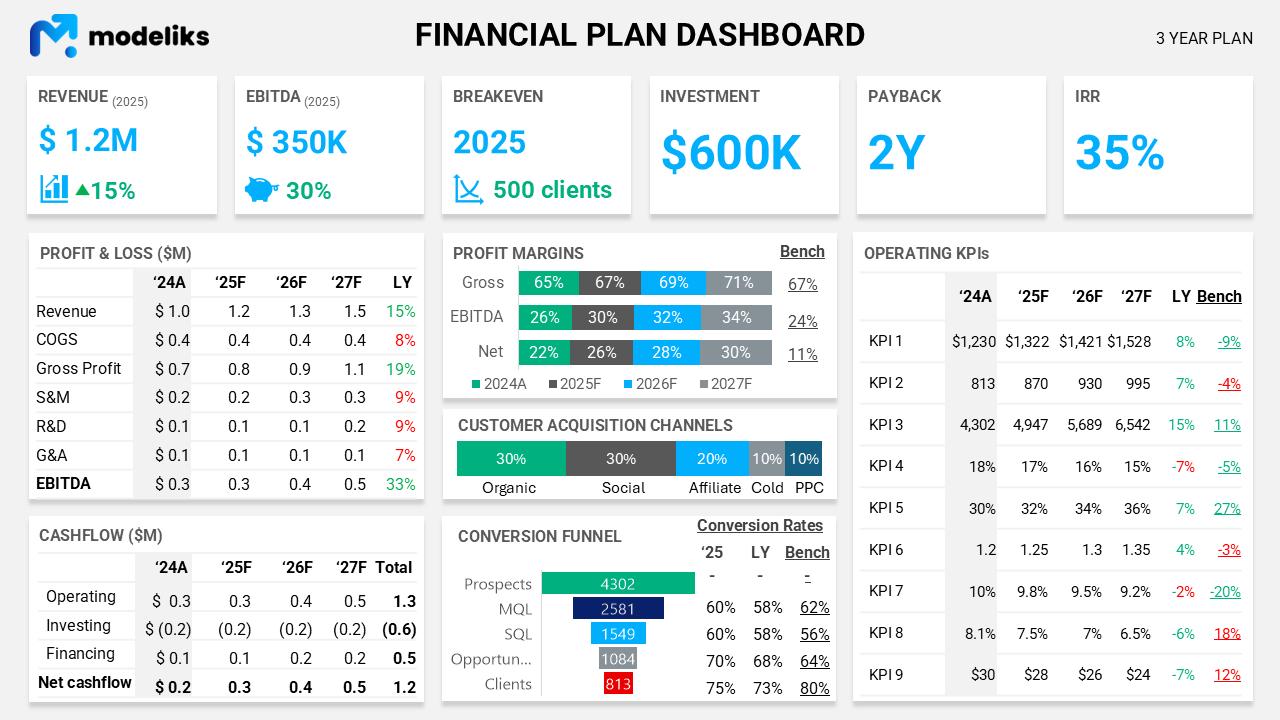
Beyond this one-page summary of your plan, you will need the three projected financial statements:
- Profit and Loss: Tracks the restaurant’s revenues, costs, and profits over time.
- Balance Sheet: A snapshot of the restaurant’s financial condition at a specific moment.
- Cash Flow Statement: Demonstrates how changes in the balance sheet and income affect cash and cash equivalents.
Full-Service Restaurants financial model summary
A professional Full-Service Restaurants financial model will assist you in contemplating your business, identifying resources you need to achieve your targets, setting goals, measuring performance, raising funding, and making confident decisions to manage and grow your business. By meticulously planning each aspect, you can ensure that your restaurant not only survives but thrives in a competitive marketplace. Although this may seem daunting, it is essential because without such a model, you risk falling behind your competitors.
If you need help with your financial plan, try Modeliks , a financial planning solution for SMEs and startups or contact us at contact@modeliks.com and we can help.
Author:
Blagoja Hamamdjiev
, Founder and CEO of
Modeliks
, Entrepreneur, and business planning expert.
In the last 20 years, he helped everything from startups to multi-billion-dollar conglomerates plan, manage, fundraise, and grow.