



Our Gourmet Food Delivery Financial Model Structure covers all the essential aspects you need to consider when starting or scaling a Gourmet Food Delivery business. By following this structure, you can better understand your revenue streams, costs, and assets, helping you optimize profitability and strategically plan for growth.
Embarking on a gourmet food delivery business presents an exciting opportunity to serve discerning customers with high-quality meals delivered to their doorsteps. However, success in this venture hinges significantly on meticulous financial planning. The gourmet food delivery financial model is designed to outline typical revenues, direct costs, employees, expenses, and assets that are essential when starting or growing your business. By exploring this model, entrepreneurs can uncover ideas for new and profitable revenue streams.
Gourmet Food Delivery Financial Model Structure
This gourmet food delivery financial model structure provides valuable insights, although it requires thoughtful consideration of various factors. Because of this, one must remain diligent and adaptable in order to thrive in such a competitive market.
Revenues
Revenue streams in a Gourmet Food Delivery business can be quite diverse; however, they typically fall into several categories:
- Subscription Services: Revenue is calculated by multiplying the subscription fee by the number of subscribers.
- A la Carte Orders: Revenue is determined by the price of each meal multiplied by the number of meals sold.
- Corporate Catering: Calculate by the total value of catering contracts over a specific period.
- Bulk Meal Orders: Similarly assessed as a la carte, but with volume discounts considered.
- Loyalty Programs: Earnings from loyalty programs based on membership fees or accumulated points redeemed.
- Event Partnerships: Revenue from co-hosted events, calculated by a share of ticket sales. This method is particularly effective for maximizing profit.
- Gift Vouchers: Includes the sale and redemption of gift vouchers, contributing to overall revenue.
Cost of Goods Sold
These reflect the direct costs attributable to the production of meals. However, they can vary significantly due to multiple factors. This variability is important to consider, but it often goes unexamined. Although the expenses may seem straightforward, they involve numerous hidden costs that can impact budgeting. Because of this complexity, a deeper analysis is essential for understanding the true financial implications.
- Ingredient costs
- Packaging materials
- Delivery logistics
- Kitchen equipment maintenance
- Chef and kitchen staff salaries
Employees
Crafting a team with diverse skills is essential. Typical roles include:
- Executive Chef: Oversees the kitchen operations and menu creation.
- Kitchen Staff: Assists in meal preparations and maintains kitchen efficiency.
- Delivery Drivers: Ensures meals reach customers promptly and in perfect condition.
- Marketing Manager: Develops strategies to reach potential customers.
- Customer Service Representatives: Handles customer inquiries and resolves service issues.
- Financial Analyst: Manages financial planning, budgeting, and reporting.
However, although these roles are distinct, they must work together effectively because this ensures overall success.
Operating Expenses
Contemplate these typical operating expenses that are essential for your gourmet food enterprise:
- Rent for commercial kitchen space
- Utility bills (gas, electricity, water)
- Marketing and advertising expenses
- Software subscriptions for order management
- Website maintenance costs
- Professional services (accounting, legal)
- Inventory replacement and wastage
- Vehicle maintenance and fuel costs
- Insurance premiums
- Office supplies
Software subscriptions for order management have become increasingly popular among businesses. However, some companies struggle to find the right solution. This is primarily because many options exist, each with its own set of features and pricing structures. Although some users prefer comprehensive packages, others may opt for more streamlined services. The choice ultimately depends on specific needs and budget constraints. Consideration of these factors is essential; however, making a decision can be overwhelming at times. In the end, the right software can significantly enhance operational efficiency, thus improving overall performance.
Assets
Typically required assets might include:
- Commercial kitchen equipment
- Delivery vehicles
- IT infrastructure, including computers and software
- Furniture for office space
- Inventory of raw food ingredients
IT infrastructure, which encompasses both computers and software, plays a crucial role in today’s digital landscape. However, many organizations fail to recognize its importance. This oversight can lead to inefficiencies, because outdated systems or poorly integrated software may hinder productivity. Although some may argue that upgrading is costly, the long-term benefits often outweigh the initial investment. There are several factors to consider: compatibility, scalability, and security. But, without a solid IT foundation, even the most innovative solutions may fall short of expectations.
Funding Options
Main funding options might be:
- Bank loans
- Angel investors
- Venture capital
- Crowdfunding platforms
- Government grants for food businesses
Driver-Based Financial Model for Gourmet Food Delivery
A truly professional Gourmet Food Delivery financial model is grounded in the operating KPIs (often referred to as “drivers”) pertinent to the enterprise.
- Order Volume (the number of orders received) is crucial, as it reflects demand patterns.
- Average Order Value indicates the mean monetary worth of an order.
- Customer Acquisition Cost represents the expense tied to converting a potential lead into a customer.
- Churn Rate (the percentage of customers who cease ordering) can be alarming if high.
- Delivery Time is the average duration from order placement to doorstep, affecting customer satisfaction.
- Gross Margin—revenues minus cost of goods sold, expressed as a percentage—is vital for profitability.
- Rate of Repeat Orders signifies the frequency with which existing customers re-order, implying loyalty.
- Average Delivery Cost pertains to the typical expense incurred for delivering an order.
- Utilization Rate of Kitchen Capacity reflects the extent to which kitchen resources are utilized efficiently.
However, understanding these metrics is essential because they directly impact the success of the business.
Driver-based financial planning represents a method of identifying key activities (often referred to as ‘drivers’) that exert the greatest influence on your business outcomes. Subsequently, you construct your financial plans around these activities. This approach enables the establishment of relationships between financial results and the resources required to attain those results (including personnel, marketing budgets, equipment, etc.).
If you wish to delve deeper into driver-based financial planning and understand why it is the optimal strategy for planning, you should watch the founder of Modeliks elucidate this concept in the video below.
The Financial Plan Output
The objective of the financial forecast outputs should enable you, your management, board, or investors to:
- Quickly grasp how your Gourmet Food Delivery enterprise will operate in the future.
- Get assurance that the plan is well-considered, realistic, and attainable.
- Understand what investment is necessary to implement this plan, as well as what the return on that investment will be.
To attain these objectives, here is a one-page template on how to effectively present your financial plan.
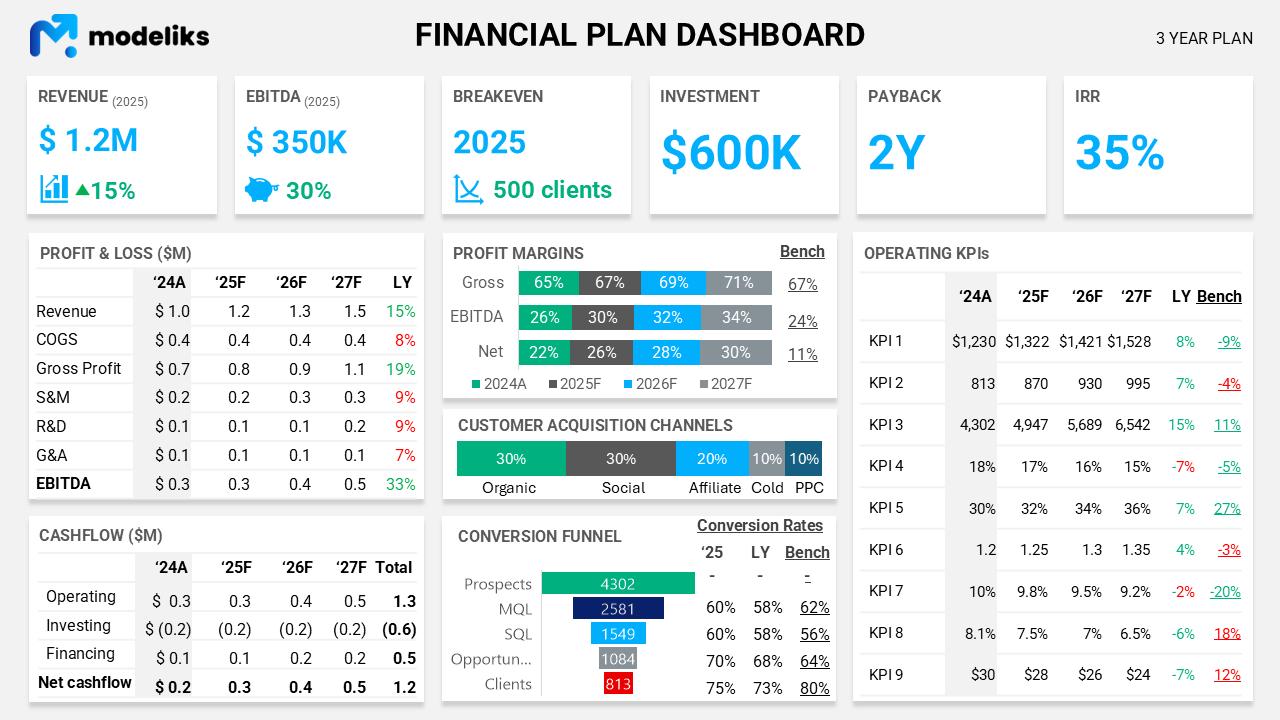
Apart from this one-page overview of your plan, you will require the three projected financial statements:
- Profit and Loss
- Balance Sheet
- Cash Flow Statement
Gourmet Food Delivery Financial Model Summary
A professional Gourmet Food Delivery financial model will assist you in contemplating your business. It helps identify resources needed to achieve targets, set goals, measure performance, raise funding, and make confident decisions to manage and grow your business. Although it may seem complex, the model proves invaluable because it provides clarity and direction.
If you need help with your financial plan, try Modeliks , a financial planning solution for SMEs and startups or contact us at contact@modeliks.com and we can help.
Author:
Blagoja Hamamdjiev
, Founder and CEO of
Modeliks
, Entrepreneur, and business planning expert.
In the last 20 years, he helped everything from startups to multi-billion-dollar conglomerates plan, manage, fundraise, and grow.