



Our Juice Bar Financial Model Structure covers all the essential aspects you need to consider when starting or scaling a Juice Bar business. By following this structure, you can better understand your revenue streams, costs, and assets, helping you optimize profitability and strategically plan for growth.
Initiating a juice bar enterprise represents an exhilarating opportunity—one that possesses considerable potential for both growth and profitability. A pivotal step towards achieving this success is financial planning: it guarantees a comprehensive understanding of revenues, direct costs, employee dynamics, expenses, and the assets involved. Establishing a Juice Bar financial model can serve not only to guide you as you embark on your business journey, however, it can also yield valuable insights into emerging and profitable revenue streams. Although the process may seem daunting, this foundation is essential for long-term sustainability.
The Juice Bar financial model structure
Revenues
Revenue streams (often considered the lifeblood) of a Juice Bar business are essential. Typical streams may include:
- Fresh Juice Sales, which are calculated by multiplying the number of juices sold by the price per unit.
- Smoothie Sales, similar to juice sales, have potentially different pricing; however, both rely on customer preferences.
- Bottled Juices involve selling pre-packaged juices at retail locations, calculated according to sales volume and unit price.
- Subscription Plans generate recurring revenue from customers who opt for weekly or monthly subscriptions, which is effective because it establishes a steady income.
- Food Pairings yield revenue from selling snacks or small meals paired with juices, creating an attractive offering.
- Promotional Events produce income from hosting and providing juice services at various events.
- Retail Merchandise involves selling branded items like tumblers, driven by unit sales and pricing strategies.
- Workshops or Classes allow for charging customers to learn about juice making or wellness benefits, thus diversifying the Juice Bar financial model in a competitive market.
Cost of goods sold
The cost of goods sold (COGS) for a Juice Bar will encompass costs associated with the production of goods, including:
- fruit and vegetable purchase costs,
- packaging expenses,
- costs for any additional ingredients like sweeteners or ice.
However, this calculation can be complex because it involves various factors. Although the expenses may seem straightforward, they can fluctuate significantly.
Employees
Typical employees in a Juice Bar include:
- Bar Manager: Oversees operations, staff schedules, and inventory management.
- Juice Barista: Prepares juices and smoothies, ensuring product quality and customer service.
- Cashier: Manages transactions and customer inquiries at the counter.
- Marketing Coordinator: Develops promotions and manages social media content.
- Stock Clerk: Handles inventory management and restocking supplies, this role is crucial because it supports overall efficiency.
Operating expenses
Operating expenses (which are crucial for daily operations) include various elements:
- Rent (the cost of leasing Juice Bar location).
- Utilities (this encompasses electricity, water and gas).
- Payroll (salaries and wages for staff).
- Marketing (expenses for advertising and promotions).
- Supplies (the cost of non-inventory items, like cleaning supplies).
- Insurance (liability and property premiums are often overlooked, but they play an essential role in financial stability).
- Licenses and permits (regulatory fees required to operate) can be a burden, although necessary for compliance.
- Maintenance, which encompasses repairs and upkeep of equipment, is vital because neglecting it can lead to larger issues down the line.
- Technology (expenses associated with POS systems and software) is increasingly important in today’s market; this investment can streamline operations.
- Professional fees (costs for accounting or legal services) are another consideration and while they might seem like an extra expense, they often save money in the long run.
However, without proper management of these expenses, profitability may suffer. Although they may seem straightforward, understanding their impact is essential, because they directly affect financial sustainability. This complexity often goes unnoticed, but it is fundamental to maintaining operational efficiency.
Assets
Typical assets include:
- Juicing Equipment: Essential for preparing juices and smoothies, is crucial; however,
- Refrigeration Units: Required for storing fresh produce and bottled juices.
- Furniture and Fixtures: Tables, chairs, and counters for service areas.
- Point of Sale Systems: For efficient transaction processing.
Although these components are diverse, they collectively contribute to a successful juicing business. This integration is fundamental because it ensures a seamless customer experience.
Funding Options
Common funding options for Juice Bars include:
- Bank Loans (which are traditional lending from banks requiring collateral),
- Angel Investors (individuals who provide capital in exchange for equity),
- Venture Capital (investment funds that seek high-growth potential businesses).
- Crowdfunding is also a viable option—raising small amounts of money from a large number of people, typically online.
However, each method has its pros and cons; this can complicate the decision-making process. Although some may prefer the security of bank loans, others might be drawn to the flexibility of crowdfunding.
Driver-based financial model for Juice Bar
A truly professional financial model for a Juice Bar business is structured around operating KPIs (key performance indicators) relevant to this industry. These indicators help in making informed decisions and projecting future outcomes; however, they also present challenges. For instance, customer footfall (the number of customers visiting the Juice Bar daily or monthly) is crucial, but it can fluctuate significantly. The average transaction value —indicating the average amount spent by each customer—offers insight into consumer spending habits. Juice yield per batch reveals the quantity of juice produced from a standard batch of fruits, while waste percentage reflects the percentage of ingredients lost or spoiled. Daily production capacity , which denotes the maximum volume of juice that can be produced each day, is essential for managing resources effectively. Employee turnover rate shows the rate at which employees leave the business and must be replaced; this can impact morale and efficiency. Monthly subscription rate measures the number of customers enrolled in subscription services, emphasizing customer loyalty. Social media engagement indicates the level of follower interactions on platforms, influencing brand visibility. Revenue per square foot measures the efficiency of space usage in generating revenue, thus impacting profitability. Although customer satisfaction score provides feedback-based metrics indicating satisfaction levels, it is crucial to interpret these insights critically.
Driver-based financial planning involves identifying and focusing on key activities or ‘drivers’ that significantly impact your business results. This planning allows one to create a link between financial outcomes and needed resources: personnel, marketing and equipment investments. If you want to know more about driver-based financial planning and why it is the right way to plan, see the founder of Modeliks explaining it in the video below.
The financial plan output
The objective of financial forecast outputs is to present you and your management, board, or investors with a clear depiction of how your Juice Bar enterprise will perform in the future. It also ensures that the plan is thoughtful, realistic, and actionable—highlighting potential investments and their anticipated ROI. To attain these goals, here’s a one-page template on how to effectively convey your financial plan.
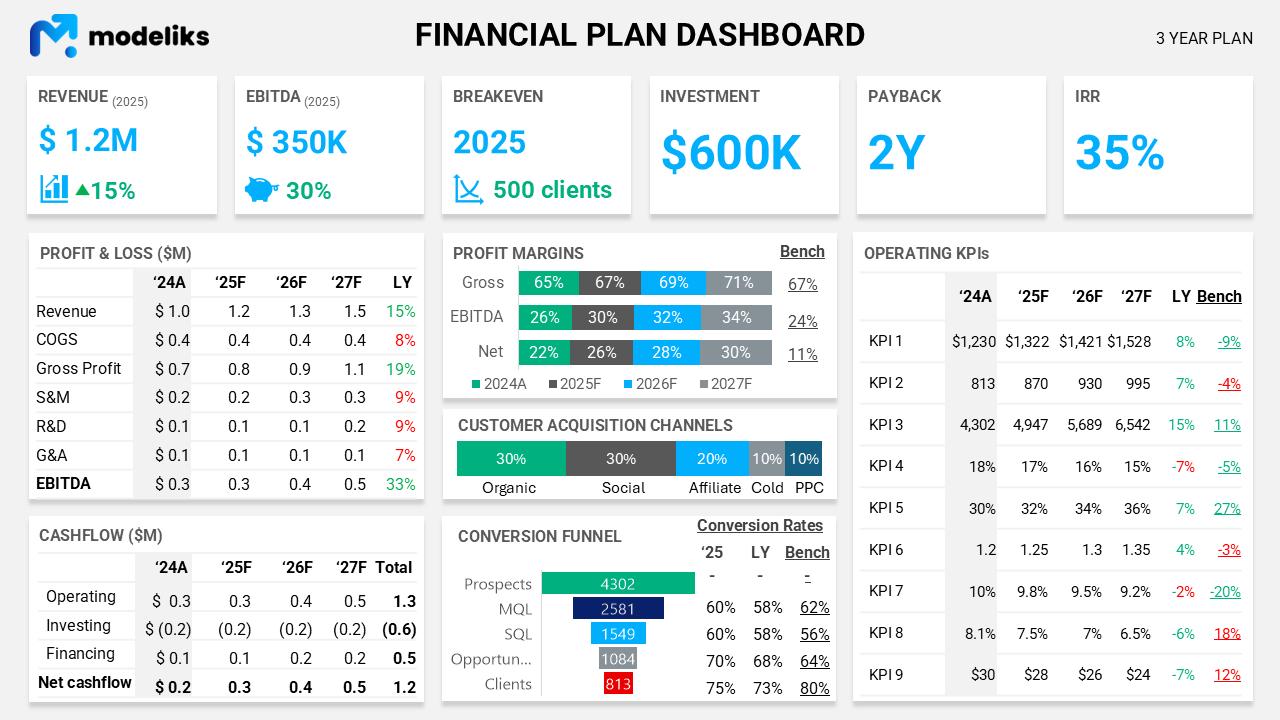
Apart from this one-page summary of your plan, you will require three projected financial statements: Profit and Loss (a statement illustrating revenues, costs, and expenses over a specific period), Balance Sheet (a snapshot of the business’s financial position at a certain point in time), and Cash Flow Statement (a record detailing the inflows and outflows of cash). However, achieving clarity in these documents is crucial, because it can significantly impact investor confidence. Although this is a concise overview, the details matter greatly.
Juice Bar financial model summary
A professional Juice Bar financial model serves as a roadmap; assisting you in thinking through your business strategy, identifying necessary resources, setting goals, measuring performance, and securing funding. However, it empowers you to make data-driven decisions confidently—this is essential for managing and expanding your business successfully. Although the process may seem daunting, it is imperative to utilize such a model because it can significantly enhance your overall effectiveness.
If you need help with your financial plan, try Modeliks , a financial planning solution for SMEs and startups or contact us at contact@modeliks.com and we can help.
Author:
Blagoja Hamamdjiev
, Founder and CEO of
Modeliks
, Entrepreneur, and business planning expert.
In the last 20 years, he helped everything from startups to multi-billion-dollar conglomerates plan, manage, fundraise, and grow.