



Our Meal Prep and Delivery Services Financial Model Structure covers all the essential aspects you need to consider when starting or scaling a Meal Prep and Delivery Services business. By following this structure, you can better understand your revenue streams, costs, and assets, helping you optimize profitability and strategically plan for growth.
Financial planning is essential for establishing or expanding a Meal Prep and Delivery Services business. A robust Meal Prep and Delivery Services financial model can provide insights into potential revenue streams, direct costs, required employees, operating expenses, assets, and funding opportunities. This comprehensive approach not only clarifies financial operations but also uncovers new and profitable revenue streams that might not have been initially considered. The Meal Prep and Delivery Services financial model structure, however, requires careful consideration of various factors because it influences overall success and sustainability. Although it may seem daunting, understanding these elements is critical for long-term growth.
The Meal Prep and Delivery Services financial model structure
Revenues
The typical revenue streams for a Meal Prep and Delivery Services business (that is, those that provide prepared meals directly to consumers) encompass several categories:
- Subscription Plans: Determined by multiplying the number of subscribers with the subscription fee.
- A la Carte Sales: Revenue accrued from individual meal purchases, calculated by units sold multiplied by the sale price per unit.
- Catering Services: Figured by events catered times the average catering fee per event.
- Corporate Contracts: Recurring income from corporate partnerships, derived from the contractual amount received over a specific period.
- Retail Sales: Revenue generated from selling meals through third-party retailers, calculated by retail units sold multiplied by the wholesale price per unit.
- Gift Cards: Calculated by the number of gift cards sold times the card value.
- Seasonal Promotions: Revenue derived from short-term special offers, calculated by units sold during promotional times multiplied by the promotional price.
However, the effectiveness of each stream can vary significantly because market demand fluctuates and this can affect overall profitability. Although some streams may yield higher returns, others may require more investment to maintain.
Cost of goods sold
The corresponding cost of goods sold (COGS) includes:
- Ingredients and Materials
- Packaging Costs
- Transportation and Delivery Costs
- Production Labor Costs
- Kitchen Facility and Utilities
Employees
The typical employees needed in this business include:
- Chef: Responsible for menu planning and meal preparation.
- Kitchen Staff: Assists in cooking, packaging and maintaining kitchen operations.
- Delivery Drivers: Ensures timely and efficient delivery of meals to customers.
- Customer Service Representatives: Handles customer inquiries, complaints and orders.
- Marketing Specialist: Develops marketing campaigns and strategies to attract and retain customers.
- Operations Manager: Oversees day-to-day operations and logistic management.
- Sales Executive: Focuses on acquiring corporate clients while maintaining business relationships, however, the roles can shift because of evolving demands.
Although these positions are distinct, they collectively contribute to operational success. This complexity in roles often presents challenges, but also opportunities for growth.
Operating expenses
Typical operating expenses include:
- Rent: The cost of leasing kitchen and office space.
- Utilities: Charges for water, electricity, and gas necessary for kitchen operations.
- Insurance: Provides coverage for business liability and property damages; however, this is essential for mitigating risks.
- Marketing and Advertising: Costs, encompassing both online and offline activities, are crucial for growth.
- Technology and Software: Expenses arise from the need for digital tools employed in inventory management, accounting, and marketing efforts.
- Salaries and Wages: Represent compensation not just for employees’ services but also for their contributions to the overall success of the business.
- Training and Development: Budgets are allocated for the enhancement of employee skills because investing in staff is vital for long-term success.
- Cleaning and Maintenance: Costs relate to ensuring kitchen hygiene and proper equipment servicing; although necessary, these can be overlooked.
- Office Supplies: Consist of general expenses like stationery; while this may seem minor, it accumulates.
- Professional Fees: Fees for consulting or legal advice; though sometimes viewed as unnecessary, they are indeed an investment in the business’s resilience and compliance.
Assets
Essential assets for the business include:
- Kitchen Equipment: Includes ovens, stoves and other essential cooking tools.
- Delivery Vehicles: Vehicles specifically used for meal delivery purposes.
- Office Equipment: Computers, telephones, and furniture necessary for administrative functions.
- Inventory System: Software or tools used to manage inventory effectively; however, the efficiency of these systems can vary.
This is important, because without proper management, inventory can quickly become unmanageable. Although some may argue that traditional methods suffice, modern technology offers significant advantages.
Funding options
Common funding options include:
- Bank Loans: Traditional loans from financial institutions, contingent upon business creditworthiness.
- Angel Investors: Affluent individuals who provide capital for start-ups.
- Venture Capital: Involves funding from venture capitalists in exchange for equity in the business.
- Business Grants: Funds awarded by government or private institutions without an expectation of repayment; significant because it allows businesses to grow without incurring debt.
- Crowdfunding: The act of collecting small amounts of money from a large number of people, typically via the internet, has gained popularity in recent years.
A truly professional Meal Prep and Delivery Services financial model is based on the operating KPIs (also known as “drivers”) relevant to the Meal Prep and Delivery Services business, although it requires careful consideration and analysis.
Driver-based financial model for Meal Prep and Delivery Services
Examples of key KPIs include:
- Customer Acquisition Cost (CAC): This refers to the expense incurred when acquiring a new customer.
- Customer Retention Rate: The rate at which customers persist in utilizing the service over a specified period.
- Average Order Value (AOV): This denotes the average revenue generated from each customer order.
- Monthly Recurring Revenue (MRR): The revenue produced each month from subscriptions, however, this can fluctuate.
- Delivery Efficiency: Average time taken to deliver orders to customers, although factors like distance can complicate this.
- Churn Rate: The percentage of customers who discontinue their subscriptions within a given timeframe.
- Menu Popularity Index: Measures how popular various meals are on the menu because understanding preferences is crucial.
Driver-based financial planning is a process often overlooked, of identifying key activities frequently termed ‘drivers’ that exert the most significant influence on your business results. Subsequently, one builds financial plans based on those activities. It facilitates the establishment of relationships between financial outcomes and the resources necessary to achieve those outcomes (including personnel, marketing budgets, equipment, etc.).
If you desire to delve deeper into driver-based financial planning and comprehend why it constitutes the optimal approach to planning, consider watching the founder of Modeliks elucidating it in the video below.
The financial plan output
The objective of the financial forecast outputs should enable you, your management, board, or investors to quickly grasp how your Meal Prep and Delivery Services business will perform in the future. You will gain reassurance that the plan is thoroughly considered, realistic, and achievable. Furthermore, it is crucial to comprehend what investment is needed to implement this plan and what the expected return on investment will be. To accomplish these objectives, here is a one-page template regarding how to effectively present your financial plan.
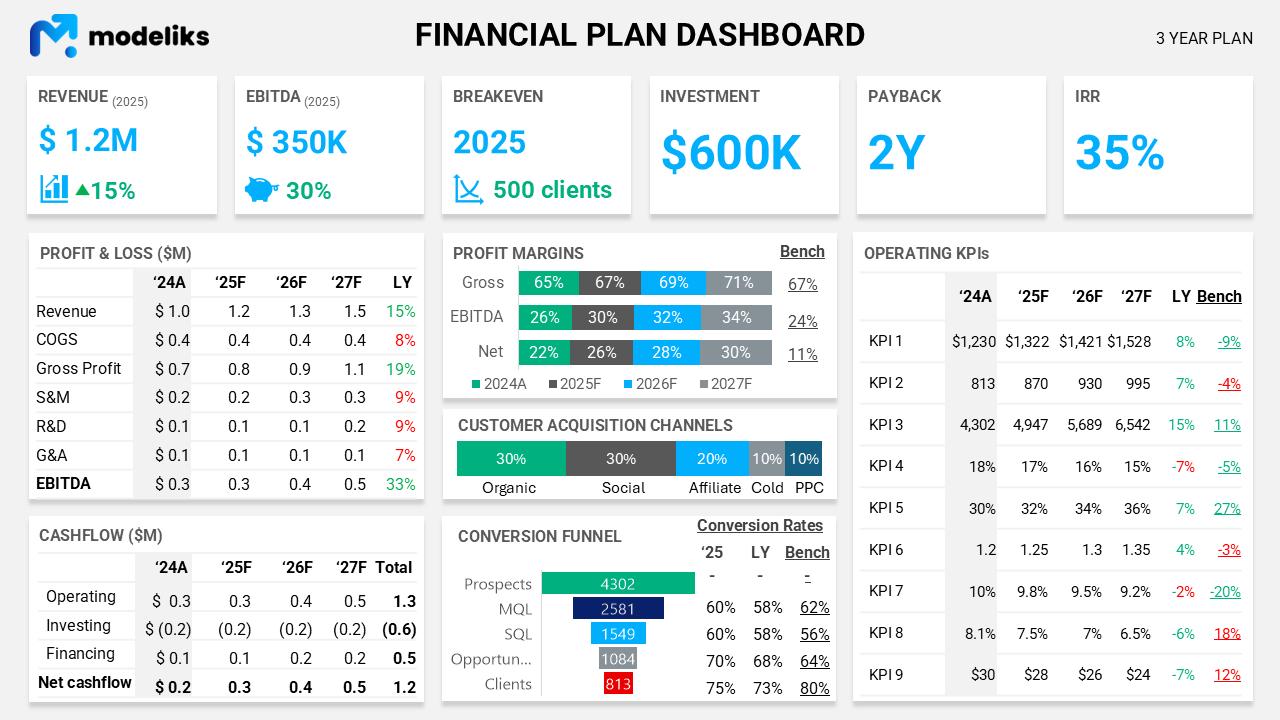
Apart from this one-page summary of your plan, you will require the three projected financial statements:
- Profit and Loss: Displays projected revenues, costs and profits.
- Balance Sheet: Shows the company’s assets, liabilities and shareholders’ equity.
- Cash Flow Statement: Presents cash inflows and outflows from operating, investing and financing activities.
Meal Prep and Delivery Services financial model summary
A professional Meal Prep and Delivery Services financial model will aid you in contemplating your business. It will help in identifying the resources needed to achieve your targets, set goals, measure performance, raise funding, and, most importantly, make confident decisions regarding managing and growing your business.
If you need help with your financial plan, try Modeliks , a financial planning solution for SMEs and startups or contact us at contact@modeliks.com and we can help.
Author:
Blagoja Hamamdjiev
, Founder and CEO of
Modeliks
, Entrepreneur, and business planning expert.
In the last 20 years, he helped everything from startups to multi-billion-dollar conglomerates plan, manage, fundraise, and grow.