


Our Mobile Kitchens Financial Model Structure covers all the essential aspects you need to consider when starting or scaling a Mobile Kitchens business. By following this structure, you can better understand your revenue streams, costs, and assets, helping you optimize profitability and strategically plan for growth.
Mobile Kitchens Model Structure
Financial planning for a Mobile Kitchens business is a crucial step that helps entrepreneurs and business owners outline the financial aspects needed for starting or expanding their ventures. A well-structured Mobile Kitchens financial model outlines typical revenue streams, direct costs, employee needs, operating expenses, and essential assets. By understanding and considering these elements, business owners can identify new, profitable revenue streams and plan effectively for their business’s financial health. This Mobile Kitchens financial model structure is vital.
Revenues
A Mobile Kitchens business can generate revenue through various streams, each calculated uniquely. They include:
- Food Sales: Calculated by multiplying the number of meals sold by the price per meal.
- Beverage Sales: Derived from the quantity of beverages sold multiplied by the price per drink.
- Catering Services: Revenue calculated from the number of events catered multiplied by average catering fees.
- Delivery Revenue: Calculated by the number of deliveries times the delivery fee per order.
- Merchandise Sales: Revenue from selling branded items, calculated by the quantity sold times the price per item.
- Event Participation Fees: Fees collected for participating in events or festivals.
- Franchise Fees: Revenue generated from franchising your Mobile Kitchens model, however, the effectiveness can vary based on location and demand.
Cost of Goods Sold
The Cost of Goods Sold (COGS) for these revenue streams encompasses costs directly linked to producing food, beverages, and other sellable items. Typical COGS involves ingredient costs, packaging, and specific kitchen supplies needed for preparation; however, it can vary greatly depending on the type of product. This variation is significant because it influences overall profitability, although many businesses overlook it.
Employees
Typical employees required in a Mobile Kitchens business include:
- Chef: Responsible for meal preparation and kitchen operations.
- Kitchen Assistant: Helps in meal prep and maintaining hygiene standards.
- Cashier/Server: Manages customer service and payment processing.
- Driver: Delivers orders to customers or event locations.
- Manager: Coordinates operations, manages staff, however oversees daily activities.
Operating Expenses
Typical operating expenses in a Mobile Kitchens business encompass various categories:
- Fuel: Includes costs for operating the kitchen’s vehicle.
- Repairs and Maintenance: Involves periodic servicing of the mobile unit.
- Licensing and Permits: Fees required for obtaining necessary operational licenses.
- Marketing and Advertising: Significant expenses because they cover costs associated with promoting the business.
- Utilities: Expenses for gas and electricity are essential.
- Insurance: Protects against potential liabilities.
- Rentals: Pertains to leasing additional kitchen equipment or storage.
- Stationery and Supplies: Items needed for day-to-day operations.
- Internet and Software: Vital for managing orders and digital operations; however, staff training is crucial as it ensures employees are well-versed with the business standards and operations.
Assets
The most typical assets required for a Mobile Kitchens business include:
- Mobile Kitchen Unit: The vehicle equipped with a kitchen setup.
- Specialized Kitchen Equipment: Such as grills and fryers.
- Point of Sale (POS) System: For handling transactions efficiently.
- Storage Units: For ingredients and supplies.
- Generator: For powering the unit when necessary.
However, each asset plays a crucial role in the overall success of the operation. Although some might underestimate their importance, this equipment is essential because it ensures smooth operation during service hours.
Funding Options
Typical funding options for a Mobile Kitchens business include:
- Bank Loans: Traditional financing through banks.
- Investor Financing: Capital raised by pitching to potential investors.
- Grants: Non-repayable funds from governmental or private sources.
- Bootstrapping: Using personal savings or funds from family and friends.
- Crowdfunding: Raises small amounts of money from a large number of supporters.
Driver-Based Financial Model for Mobile Kitchens
A truly professional Mobile Kitchens financial model is based on the operating KPIs (commonly referred to as “drivers”) relevant to the business. Key performance indicators (KPIs) for a Mobile Kitchens business may include:
- Average Order Value (AOV): The average spending of a customer per order.
- Customer Footfall: The number of customers visiting the food truck daily.
- Daily Sales Volume: The number of sales transactions completed each day.
- Cost per Meal: The overall cost associated with preparing a single meal.
- Occupancy Rate: The rate at which the mobile kitchen is operational versus idle.
- Event Conversion Rate: The percentage of inquiries that convert into actual events or catering orders.
- Break-even Point: The sales amount needed to cover all expenses.
However, this model provides insights into performance and efficiency, although adjustments may be necessary because of varying market conditions. Driver-based financial planning is about identifying key activities (often referred to as ‘drivers’) that have the most significant impact on business results; however, it also involves constructing financial plans based on those activities. It allows for the establishment of relationships between financial outcomes and resources necessary to accomplish those outcomes, such as people, marketing budgets, and equipment. If you want to know more about driver-based financial planning and why it is the right way to plan, see the founder of Modeliks explaining it in the video below.
The Financial Plan Output
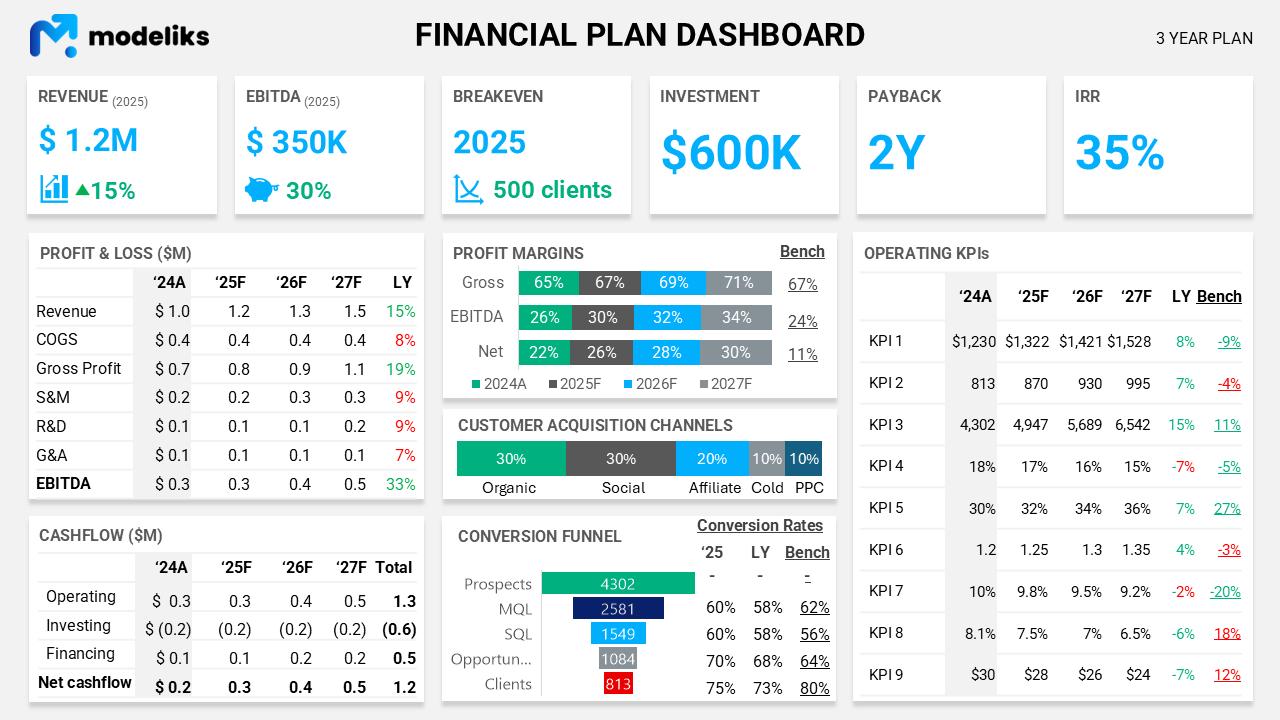
The objective of the financial forecast outputs should enable you, as well as your management, board, or investors, to quickly grasp how your Mobile Kitchens enterprise will perform in the future. Furthermore, they should provide reassurance that the plan is well thought out, realistic, and achievable. Understanding what investment is required to implement this plan—and what the anticipated return on that investment will be—is crucial. To achieve these objectives, here is a concise template (just one page!) for effectively presenting your financial plan.
In addition to this brief summary of your plan, it is necessary to include three projected financial statements:
- Profit and Loss Statement: Which tracks revenues and expenses over a specified period.
- Balance Sheet: To elucidate the assets, liabilities, and net equity at a particular moment in time.
- Cash Flow Statement: Which monitors cash inflows and outflows within your business operations.
However, successful communication of this information is vital.
Mobile Kitchens Financial Model Summary
A professional Mobile Kitchens financial model will assist you in contemplating your business. It helps identify the resources needed to achieve your targets. You can set goals, measure performance, raise funding, and make confident decisions to manage and grow your business. It provides a roadmap for the entire financial aspect of operations because it ensures that every step is well planned and executed.
If you need help with your financial plan, try Modeliks , a financial planning solution for SMEs and startups or contact us at contact@modeliks.com and we can help.
Author:
Blagoja Hamamdjiev
, Founder and CEO of
Modeliks
, Entrepreneur, and business planning expert.
In the last 20 years, he helped everything from startups to multi-billion-dollar conglomerates plan, manage, fundraise, and grow.