



Our Personal Chef Services Financial Model Structure covers all the essential aspects you need to consider when starting or scaling a Personal Chef Services business. By following this structure, you can better understand your revenue streams, costs, and assets, helping you optimize profitability and strategically plan for growth.
Personal Chef Services financial model structure
Launching or expanding a Personal Chef Services business requires a well-thought-out financial plan that serves as a roadmap for success. By outlining typical revenues, direct costs, employees, expenses, and assets, this Personal Chef Services financial model will not only provide a structured approach to the operational facets of your business, but also spark ideas for generating new and profitable revenue streams. The Personal Chef Services financial model structure is essential because it lays the groundwork for sustainable growth and adaptability.
Revenues
In a Personal Chef Services business, understanding and calculating each revenue stream is crucial for planning and growth. The typical revenue streams include:
- Private Dinner Events: Calculate revenue by multiplying the average fee per event by the number of events.
- Catering Services: Revenue is generated by offering catering for events; estimate by the number of events and average order size.
- Meal Prep Services: Multiply the number of clients by the weekly or monthly fee charged for meal preparations.
- Cooking Classes: Revenue from offering individual or group cooking classes; factor in the class fee and number of participants.
- Subscription Meal Boxes: Calculate by multiplying the number of subscriptions by the recurring fee.
- Specialty Services: Revenue from offering specialty services like dietary consultations; consider the session fee and potential clientele.
- Corporate Partnerships: Revenue from collaborations with corporate clients for employee wellness programs.
- Gift Cards: Revenue from sales of gift cards, calculated by the average value and volume sold.
However, this requires careful analysis because not all streams may yield equal profits. Although planning is essential, flexibility remains key to adapt to changing market demands.
Cost of Goods Sold
The corresponding cost of goods sold includes:
- Ingredients and groceries purchased for meal preparations.
- Packaging costs for meal delivery and catering events.
- Any outsourced labor specifically for events or larger catering services.
- Transportation costs related to ingredient delivery and meal services.
- Specialty tools or equipment needed for unique services or events.
Although these factors contribute to the overall cost, it is essential to track them accurately because they directly impact profitability.
Employees
The typical employees required in a Personal Chef Services business include:
- Head Chef: Responsible for menu planning, ingredient sourcing, and leading cooking activities.
- Line Cooks: Assist in food preparation under the guidance of the Head Chef.
- Event Coordinator: Manages booking and logistics for private dinners and catering events.
- Customer Service Representative: Handles client inquiries, bookings, and customer relations.
- Driver/Delivery Staff: Ensures timely delivery of meals or catering orders to clients.
However, it is important to note that each role contributes significantly to the overall success of the business. Although they have distinct responsibilities, teamwork is essential. This creates an environment that fosters efficiency and satisfaction, both for employees and clients alike.
Operating Expenses
Some typical operating expenses are:
- Rent: Lease payments for kitchen space or storage facilities can be significant.
- Utilities: Costs related to gas, electricity, and water are essential for preparation and cooking.
- Insurance: Liability insurance is crucial to cover food-related incidents or accidents.
- Marketing and Advertising: Expenses for promoting your services, including digital marketing efforts, require careful budgeting.
- Licensing and Permits: Fees for health permits and licenses are mandatory to operate legally.
- Professional Services: CPA or legal services are needed for business consultations and tax filings.
- Training and Development: Costs related to employee training and professional development.
- Office Supplies: Purchase of office and kitchen supplies for daily operations.
- Software Subscriptions: Costs for accounting software, scheduling tools, and CRM systems.
- Vehicle Maintenance: Expenses for maintaining delivery vehicles or mileage reimbursements.
Assets
The most typical assets needed include:
- Commercial Kitchen Equipment: Essential for preparing large quantities of food efficiently.
- Mobile Cooking Stations: Required for on-site events and demonstrations.
- Delivery Vehicles: Essential for transporting meals or catering equipment safely.
- IT Infrastructure: Computers, software, and other technology for operations.
- Inventory: Stock of ingredients and packaging materials.
Funding Options
Typical funding options include:
- Bank Loans: Traditional method, often requiring collateral and a solid business plan.
- Personal Savings: Self-funding using personal financial resources.
- Angel Investors: Individuals who provide capital in exchange for equity or convertible debt.
- Small Business Grants: Governmental or private grants offered for new and small businesses.
- Venture Capital: Investment from firms that support scalable businesses expecting high returns.
Driver-based Financial Model for Personal Chef Services
A truly professional Personal Chef Services financial model is built on key operating KPIs , also known as “drivers,” relevant to the industry. Here are some examples:
- Number of Events: Indicates the total bookings per month.
- Average Revenue per Event: Measures profitability from events.
- Client Retention Rate: Tracks repeat customers, indicating satisfaction and consistency.
- Food Cost Percentage: A key efficiency measure, calculated as a percentage of total sales.
- Average Order Size: The average value of orders, critical for pricing and profitability.
- Customer Acquisition Cost: Evaluates the expense associated with acquiring new clients.
- Employee Productivity measures output relative to labor hours, impacting costs.
- Capacity Utilization Rate indicates the percentage of operational capacity being used.
- The Sales Conversion Rate denotes the percentage of inquiries that result in bookings.
- Catering Order Lead Time refers to the time taken from booking to delivery, affecting planning and scheduling efficiency.
Driver-based financial planning involves pinpointing key business activities—often termed “drivers”—that significantly influence results. The financial plans are constructed based on these activities, establishing links between financial outcomes and the resources needed to achieve these results, such as staff, marketing budgets, and equipment. If you want to know more about driver-based financial planning and why it is the right way to plan, see the founder of Modeliks explaining it in the video below.
The Financial Plan Output
The objective of the financial forecast outputs should enable you, your management, board, or investors to quickly comprehend how your Personal Chef Services business will perform in the future. Furthermore, it should provide assurance that the plan is well-thought-out, realistic, and achievable. It is essential to understand what investment is necessary to implement this plan and what the expected return on that investment will be. To accomplish these goals, here is a one-page template on how to effectively present your financial plan:
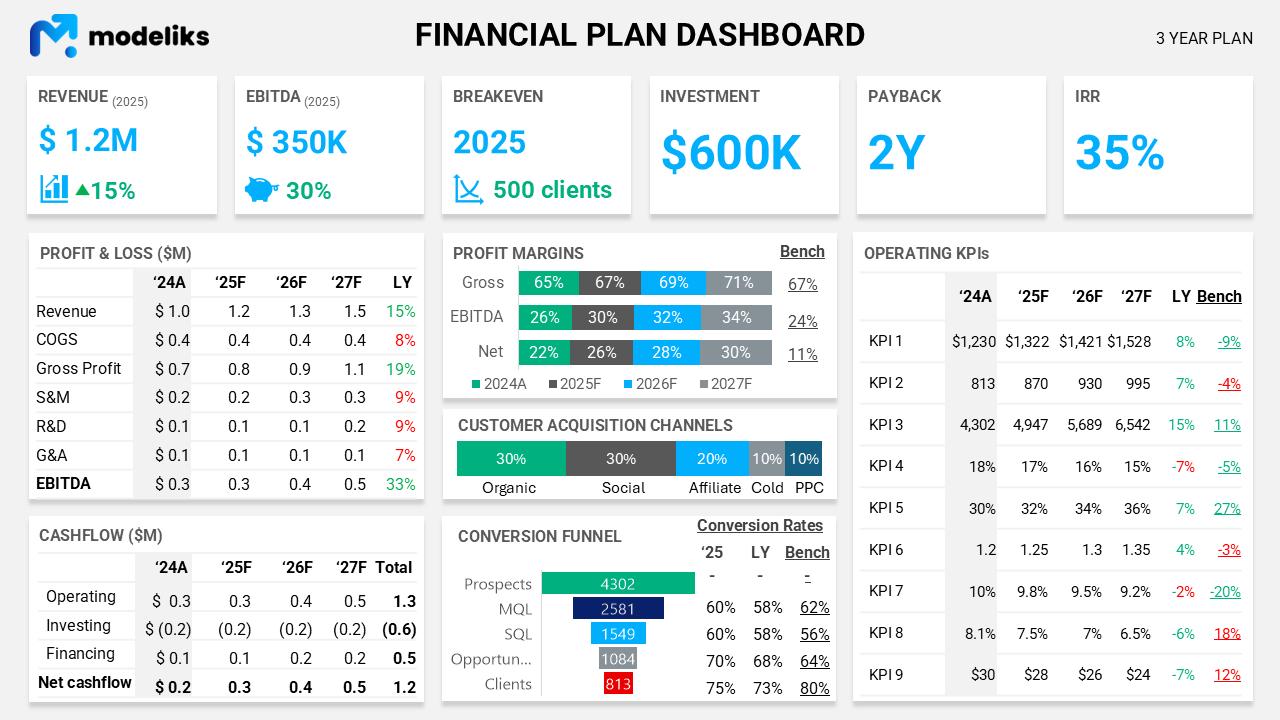
Apart from this one-page summary of your plan, you will require three projected financial statements:
- Profit and Loss: A financial statement summarizing revenues, costs, and expenses incurred during a specific period.
- Balance Sheet: A snapshot of the company’s financial position at a specific point in time, showcasing assets, liabilities, and equity.
- Cash Flow Statement: A summary of cash inflows and outflows during a given period.
Personal Chef Services Financial Model Summary
A professional Personal Chef Services financial model will enable you to think through your business, identify the resources you need to achieve your targets, set goals, measure performance, raise funding, and make confident decisions to manage and grow your business. By having a clear, structured approach to your financial planning, you will be better equipped to navigate the complexities of the personal chef services industry. However, achieving success requires diligence. Although it may seem daunting, this process is essential because it allows for better foresight and strategic decision-making.
If you need help with your financial plan, try Modeliks , a financial planning solution for SMEs and startups or contact us at contact@modeliks.com and we can help.
Author:
Blagoja Hamamdjiev
, Founder and CEO of
Modeliks
, Entrepreneur, and business planning expert.
In the last 20 years, he helped everything from startups to multi-billion-dollar conglomerates plan, manage, fundraise, and grow.